The Unsolved Murders of Tupac and Biggie
The mid-1990s represented the “Golden Era” of hip-hop, but it was also defined by a tragic, escalating tension between the East and West Coasts. At the center of this storm were two former friends turned rivals: Tupac Shakur and Christopher “The Notorious B.I.G.” Wallace. Their deaths, occurring within just six months of each other, remain the most high-profile cold cases in music history.
The Las Vegas Ambush: September 7, 1996
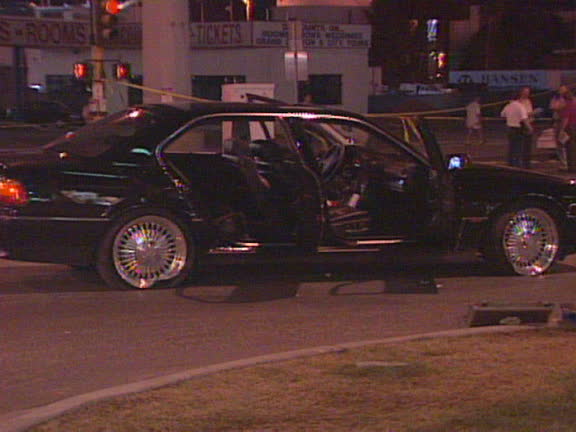
Tupac Shakur’s murder was the catalyst that changed hip-hop forever. After attending a Mike Tyson fight at the MGM Grand, Tupac and Death Row Records CEO Suge Knight were involved in a physical altercation with Orlando “Baby Lane” Anderson, a member of the Southside Crips.
The Timeline:
- 11:15 PM: While stopped at a red light on Flamingo Road and Koval Lane, a white Cadillac pulled up alongside Suge Knight’s BMW.
- The Attack: An unidentified shooter fired 14 rounds into the car. Tupac was struck four times—twice in the chest, once in the arm, and once in the thigh.
- The Aftermath: Tupac fought for his life for six days at University Medical Center before passing away on September 13, 1996.
The Los Angeles Drive-By: March 9, 1997
Six months later, the hip-hop community was still reeling when Biggie Smalls was killed in a hauntingly similar fashion. Biggie was in Los Angeles to promote his upcoming album, Life After Death, and to attempt to bridge the gap between the warring coasts.
The Timeline:
- 12:30 AM: After leaving a Soul Train Music Awards after-party at the Petersen Automotive Museum, Biggie was sitting in the front passenger seat of a GMC Yukon.
- The Attack: A dark Chevrolet Impala pulled up beside him. A man in a blue suit opened fire with a 9mm handgun.
- The Aftermath: Biggie was struck four times. Despite being rushed to Cedars-Sinai Medical Center, he was pronounced dead shortly after.
Comparing the Two Events
| Feature | Tupac Shakur | The Notorious B.I.G. |
| Location | Las Vegas, NV | Los Angeles, CA |
| Vehicle | BMW 750iL | GMC Yukon |
| Suspected Group | Southside Crips | Mob Piru Bloods / Rogue LAPD |
| Lead Suspects | Orlando Anderson / Duane “Keffe D” Davis | Wardell “Poochie” Fouse |
| Status | Recent arrest (2023) | Officially Unsolved |
The Theories and the “Cold Case” Reality
For decades, investigators and fans have debated who pulled the triggers. While the cases remained cold for over 25 years, recent developments have reignited the conversation.
1. The Retaliation Theory
The most widely accepted theory for Tupac’s murder is that it was a direct retaliation for the assault on Orlando Anderson earlier that night. In September 2023, this theory gained massive legal traction when Duane “Keffe D” Davis was arrested and charged with the murder of Tupac Shakur, allegedly having orchestrated the hit.
2. The LAPD Corruption Theory
Regarding Biggie’s death, investigator Russell Poole famously alleged that the murder was orchestrated by Suge Knight in retaliation for Tupac’s death, utilizing corrupt LAPD officers (such as David Mack) to carry out the hit. This theory suggests a cover-up within the department, which has been the subject of several documentaries and films.
3. The “Warring Coasts” Narrative
Many believe the deaths were simply the ultimate, tragic conclusion of the media-fueled East Coast-West Coast rivalry, where words on records turned into real-world violence that spiraled out of control.
The Legacy of the Kings
Despite the violence that surrounded their ends, both artists left behind an untouchable musical legacy.
- Tupac is remembered as the “Revolutionary,” a poet who spoke on social injustice and the struggles of the “thug life.”
- Biggie is hailed as the “King of Storytelling,” celebrated for his effortless flow and vivid narratives of the Brooklyn streets.
Their deaths forced the hip-hop community to look in the mirror, eventually leading to a de-escalation of the coastal “war” and a renewed focus on unity within the genre.